The new and unique Tesfa Calendar is coming out from the printers soon!
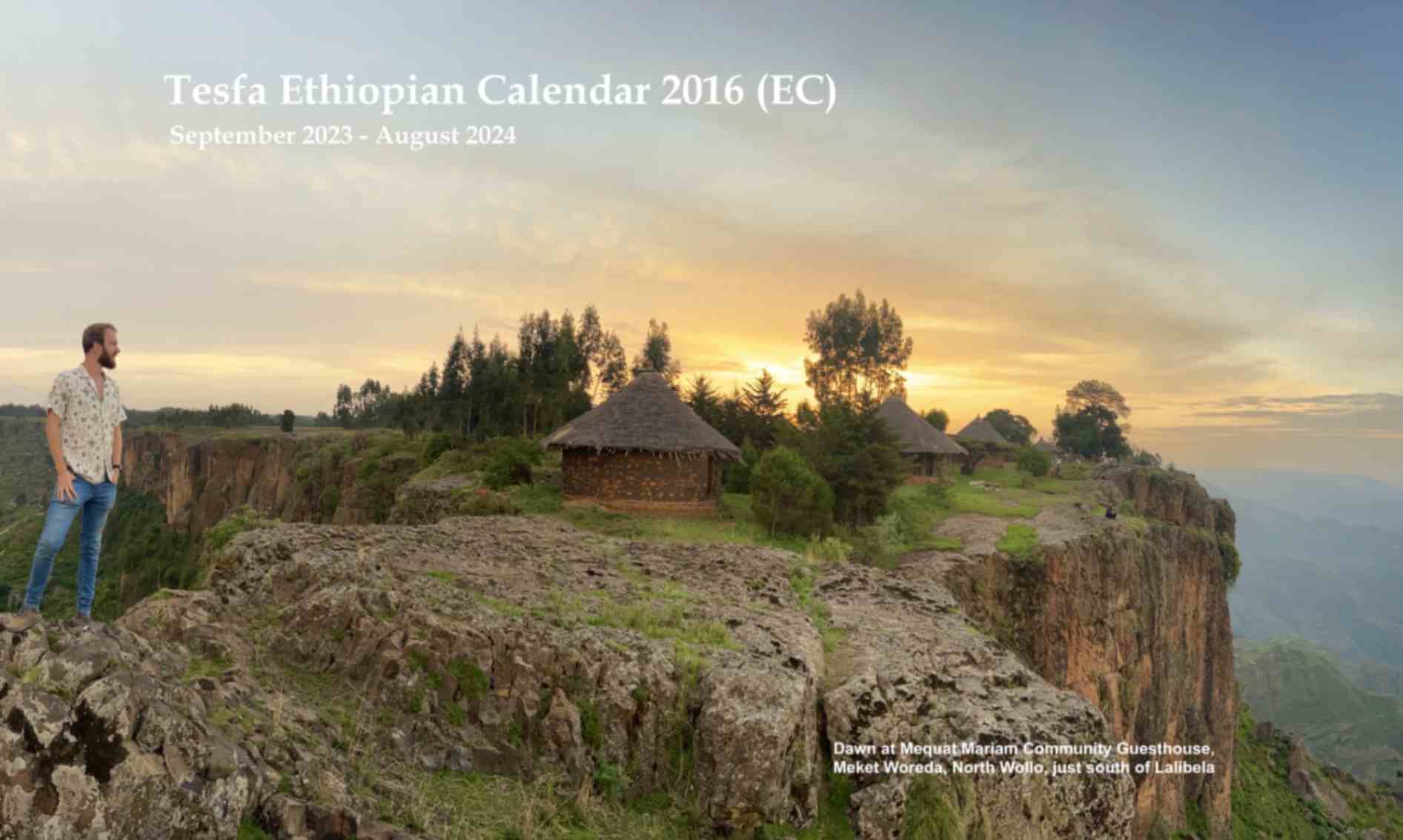
Calendar Cover page, Mequat Mariam at dawn
It runs from Sep 2023 – Aug 2024 (ie Ethiopian Year 2016) is now in its 17th year and is ready! And since the 2014 edition it is printed on recycled paper!!!
The Tesfa Calendar is available again this year, with all the Ethiopian dates set into the western calendar so you can see what is coming up. Weaving the many saints days, annual festivals, fasting periods, Islamic holidays and various curiosities, and even the full moon dates has been a labour of love for 17 years now! Conscious of the environment for the 3rd year, we are printing this on recycled paper.
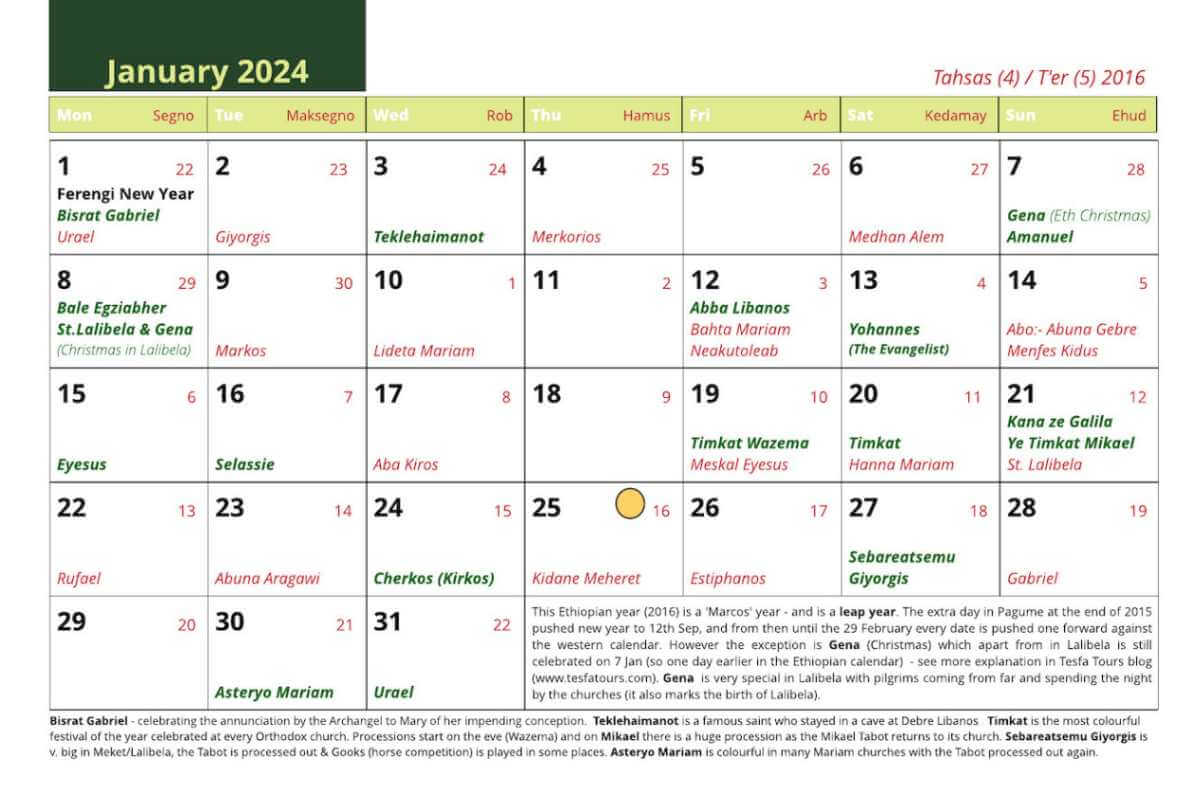
January page of the calendar
The calendar has stunning photos that will make you want to get out of Addis, or fly over from where ever you have the calendar and see this beautiful country. The photos are taken from the Tesfa Community treks across the north of the country (the Agenda has photos from other additional places too).
The calendar comes in 2 versions:
- Traditional hanging calendar, great in your kitchen or office -(29cm across ands 53cm down)- 12 months with 13 photos. 500birr donation
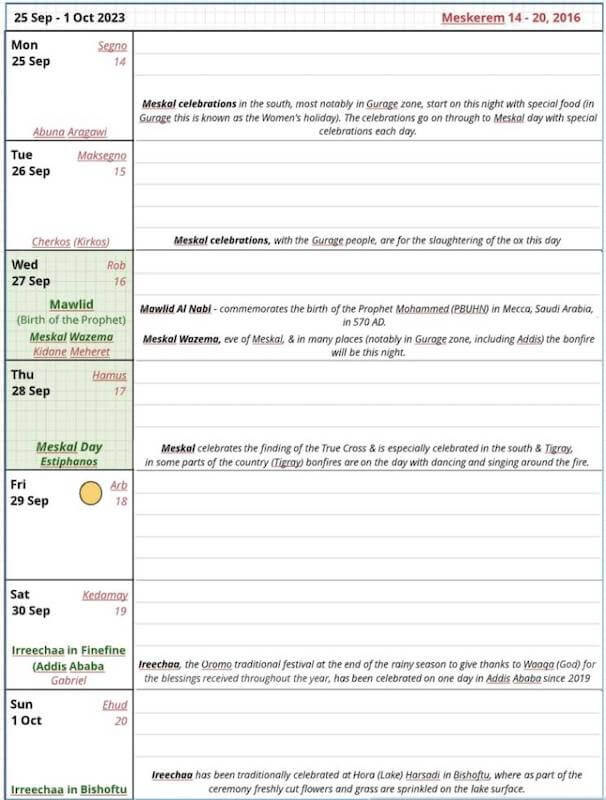
- The Agenda or Diary format:- (approx 21cm x 15cm) in portrait format, has 1 week to a page and so 53 pages (52.14 weeks a year) – running from Monday to Sunday on one side on easy to write on paper, and with a photo to match on opposite page. 600 birr donation
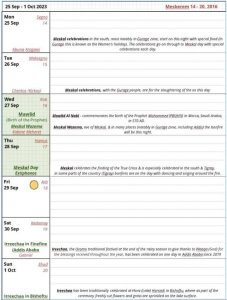
A page from the Agenda / diary
We ask the donation to help support the Tesfa communities who have guesthouses around the country hosting visitors enabling them to walk through their beautiful landscapes.
Leap Years in the Ethiopian Calendar:
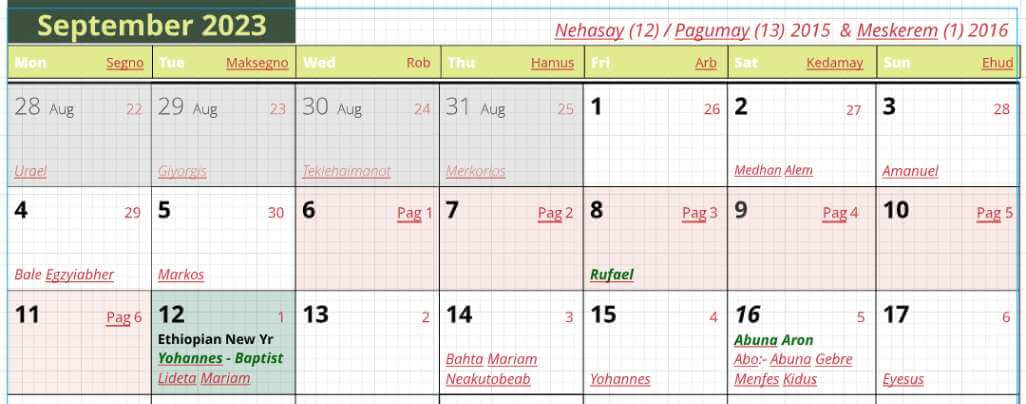 The Ethiopian calendar names the years in a 4 year procession, after the Evangelists- so this current year (2015) is a Lukas year and the coming year 2016 is a Yohannes year. At the end of a Lukas year there is an extra day in Pagumay – making it a 6 day ‘month’ which works like the 29th February in the western calendar. The effect for the coming 5 months is to knock the dates in the 2 calendars out of sync. So New Year in the Ethiopian Calendar will fall on 12th September in a Yohannes year (2016), Meskal on the 28th September, Gena (Ethiopian Christmas) – now that is more complicated – In Lalibela it shifts to the 8th January, but elsewhere in Ethiopia it remains on the 7th January (which means its on 28 Tahsas instead of the usual 29 Tahsas) – more on that later in the year! And the big one – Timkat will be on the 20 January. And around then of course all the big saints days such as Tsion Mariam are also going to shift – in this case from 30 November to 1 December. With the leap day on 29 February 2024 all the dates re-sync! Confused?, then get your copy of this calendar or the Agenda.
The Origins of the Ethiopian Calendar:
As is so much in Ethiopian culture, the origin if the Ethiopian Calendar is shrouded in the mists of time. However it is very much the same as the ancient solar Coptic calendar from Egypt, which is the oldest in history. It is believed that the famous Imhotep, the supreme official of King Djoser C.2670 B.C. played a part in the development of this calendar.
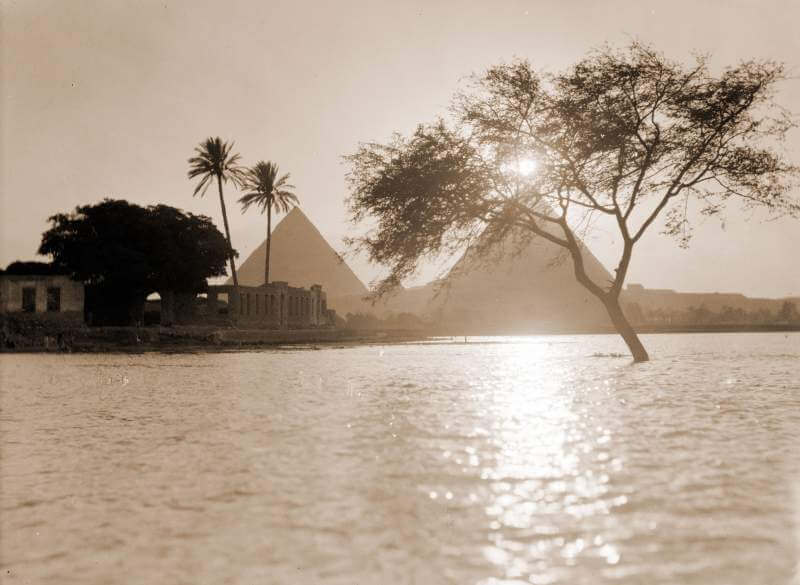
Nile flood waters at Giza by the Pyramids
Going further back the ancient Egyptians used a civil calendar based on a solar year that consisted of 365 days, without making any adjustment for the additional quarter of a day each year. Each year had 12 months and the heliacal rising of Sirius coincided with the highest point of river Nile flood at Memphis marking the first day of the year. The new year of the ancient Egyptians started on Meskerem 1 which is the date is an Ethiopian new year (which also signals the end of Noah’s flood). I’ve always enjoyed the fact that the Kremt rains in Ethiopia are what causes the Nile to flood, and marks the New year in Egypt – which became the New Year for Ethiopia too.
This ancient Egyptian Coptic solar calendar consisted of 12 x 30-day months with five extra festival days at the end of the year. This is the same concept as the Ethiopian Calendar -13 months, 12 of 30 days each and then Pagumay at the end of the year of 5
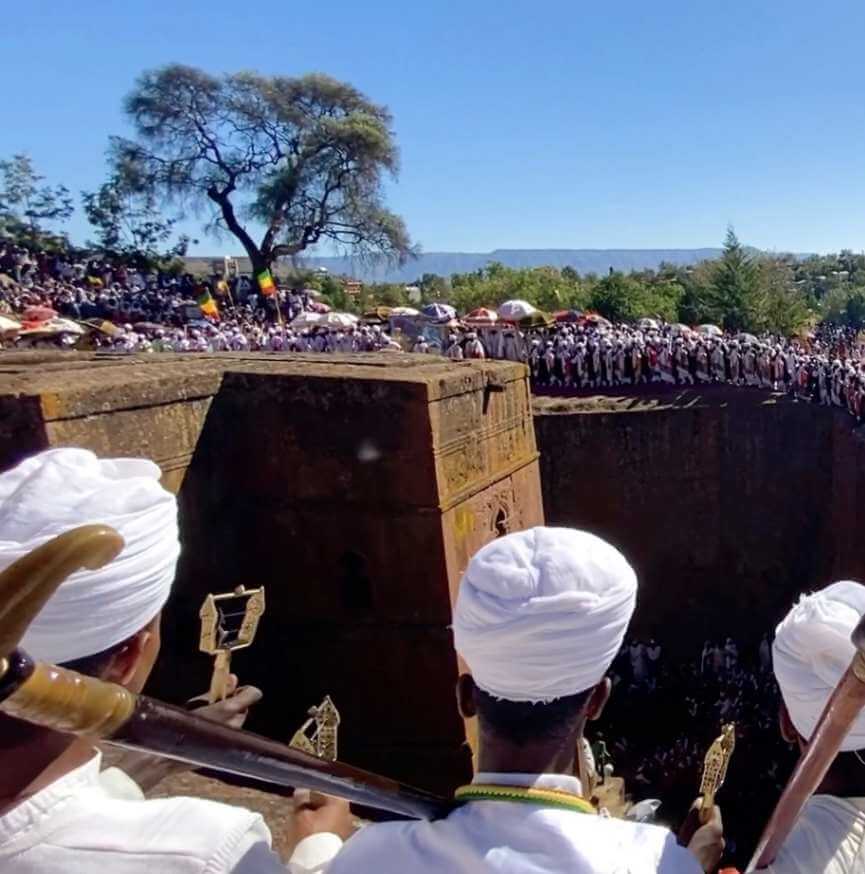
Deacons in Lalibela using Sistrum during a festival
or 6 days depending whether the year is a leap year or not. The new year starts on 11 September in the Gregorian Calendar (G.C.) or on the 12th in (Gregorian) Leap Years. The Coptic Leap Year follows the same rules as the Gregorian so that the extra month always has 6 days in a Gregorian Leap Year.
The connection between ancient Egypt and Ethiopia is unclear as the extent of territory connected to geographical names such as Nubia and Kush is debatable. However the calendar and artefacts such as the Sistrum have crossed between ancient Egypt and Ethiopia so it would seem that there was a significant cultural contact.
Get your copy of this Tesfa Calendar or Diary /Agenda and see all the upcoming dates for yourself.
To order your calendar contact Tesfa Tours 011 124 5178 / 092 349 0495, or email calendar@tesfatours.com
Our office is at Kebena, but other places around town will have copies too – contact us for more details.